

Spanish
Every child a linguist. Every language a connection to the world.
At Franciscan, we believe that learning another language opens doors to new cultures, experiences and opportunities. Spanish helps children develop confidence in communication, curiosity about the wider world and an appreciation of the many ways people express themselves.
Our Spanish curriculum is ambitious, inclusive and carefully sequenced. Supported by Kapow Primary, children develop the knowledge and skills to understand, speak, read and write in Spanish, while exploring the rich diversity of Spanish-speaking cultures and communities.
From developing early communication skills and celebrating different languages in Early Years to learning Spanish formally in Key Stage 2, children build confidence in listening, speaking and expressing their ideas.
We want every child to recognise that learning a language is more than remembering words. It is about communicating with others, understanding different cultures, making connections and discovering new ways to see the world.

Spanish at Franciscan
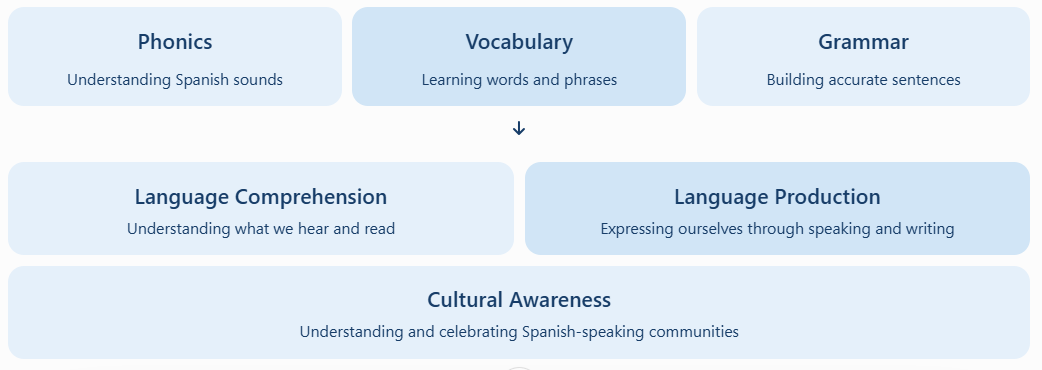
Our Spanish curriculum develops three essential areas of language knowledge: Phonics, Vocabulary and Grammar. These provide the foundations for children to understand and communicate in Spanish.
Children apply this knowledge through Language Comprehension and Language Production, while developing cultural awareness throughout their learning.
Together, these areas help children become increasingly confident and independent language learners.
Phonics – Learning How Spanish Sounds
Children are explicitly taught the sounds of Spanish and how letters and combinations of letters represent those sounds.
Through listening, repetition, teacher modelling and regular practice, they develop accurate pronunciation and begin to recognise familiar sound patterns.
As their confidence grows, children use this knowledge to understand spoken language, pronounce unfamiliar words and read Spanish more independently.
Vocabulary – Building the Words We Need
Children learn useful Spanish words and phrases that enable them to communicate about familiar topics, including themselves, their families, interests and everyday experiences.
Teachers introduce vocabulary in meaningful contexts and provide regular opportunities to revisit, practise and apply new language.
Over time, children build a growing vocabulary that supports increasingly confident listening, speaking, reading and writing.
Grammar – Understanding How Language Works
Children are explicitly taught how Spanish words and sentences are formed.
They learn to recognise and use grammatical patterns, including word order, gender, agreement and verb forms, as appropriate to their stage of learning.
Through teacher modelling and guided practice, children learn how to combine words, construct sentences and express increasingly detailed ideas.
Language Comprehension – Understanding Spanish
Children develop their ability to understand spoken and written Spanish through listening activities, stories, conversations and short texts.
They are taught to recognise familiar vocabulary, identify key information and use their knowledge of sounds and sentence structures to make sense of language.
As they progress, children become increasingly confident in understanding longer phrases and more complex messages.
Language Production – Communicating in Spanish
Children are explicitly taught to use Spanish to communicate their own ideas.
Through structured conversations, role-play, questioning, reading aloud and writing activities, they learn to express themselves with increasing accuracy and independence.
They develop the confidence to ask and answer questions, describe familiar experiences and create spoken and written sentences.
Cultural Awareness – Connecting Language and People
Throughout their learning, children explore the people, places, traditions and cultures of the Spanish-speaking world.
They learn that Spanish is spoken across many different countries and communities, each with its own experiences and traditions.
By making connections between languages and cultures, children develop curiosity, respect and a broader understanding of the world.
Our Approach to Teaching Spanish
At Franciscan, we believe confident language learning develops through explicit teaching, regular practice and meaningful communication.
Teachers introduce new sounds, vocabulary and grammatical structures in carefully planned steps. Through clear explanations, accurate modelling and guided practice, children learn how Spanish works before applying their knowledge in increasingly independent ways.
We place particular importance on oracy — listening and speaking with confidence. Children are explicitly taught how to pronounce words, listen carefully, ask and answer questions, and participate in simple conversations.
Songs, stories, games, role-play and purposeful repetition provide opportunities to practise language in engaging and memorable ways. Children also develop their reading and writing skills, learning to recognise familiar patterns and construct increasingly accurate sentences.
We teach children to think and communicate like linguists. This means noticing patterns, making connections between languages, applying grammatical knowledge and developing strategies to understand unfamiliar words.
Teachers regularly revisit prior learning, check understanding and address misconceptions, helping children retain knowledge and develop confidence over time.
Our aim is for children to become curious, resilient and increasingly independent language learners who are willing to communicate, make mistakes, learn from feedback and embrace new experiences.
How Spanish Develops Over Time
At Franciscan, language development begins long before children start learning Spanish formally.
From Pre-school through to Year 2, children develop the communication, listening and language-awareness skills that provide important foundations for learning an additional language.
Formal Spanish teaching begins in Year 3 and continues through Year 6, with carefully sequenced learning that builds children's knowledge of phonics, vocabulary and grammar alongside their communication skills.
Pre-school and Nursery – Discovering Language
In our provision for two- and three-year-olds, children develop communication and language through stories, songs, rhymes, play and meaningful interactions.
They learn to listen carefully, recognise sounds, develop vocabulary and express their ideas.
We celebrate the different languages spoken within our school community, helping children recognise that people communicate in many ways.
These early experiences build confidence, curiosity and an appreciation of language.
Reception – Building Confidence in Communication
In Reception, children continue to develop their listening, speaking and understanding through purposeful conversation, storytelling, songs and language-rich play.
They learn to recognise sound patterns, develop vocabulary, listen to others and communicate their ideas with increasing confidence.
Children encounter and celebrate different languages and cultures, developing an understanding that language connects people and communities.
This learning supports the EYFS area of Communication and Language and provides valuable foundations for future language learning.
Key Stage 1 – Strengthening Language Foundations
In Years 1 and 2, children continue developing their speaking, listening, reading and writing skills through the wider curriculum.
They learn to recognise language patterns, explore vocabulary, construct sentences and communicate with increasing clarity.
Opportunities to celebrate the languages and cultures represented within our school community help children develop curiosity about language and respect for others.
These experiences prepare children for the formal study of Spanish in Key Stage 2.
Year 3 – Beginning Our Spanish Journey
In Year 3, children begin learning Spanish through familiar and engaging topics, including greetings, numbers, colours, classroom language and everyday experiences.
They are explicitly taught Spanish sounds, essential vocabulary and simple grammatical structures.
Through songs, games, role-play and structured conversations, children develop the confidence to understand and use simple words, phrases and sentences.
Year 4 – Building Confidence and Understanding
In Year 4, children build on their knowledge of Spanish phonics, vocabulary and grammar.
They explore topics such as dates, pets, weather, food and celebrations, developing their ability to understand and communicate more detailed information.
Through regular listening, speaking, reading and writing activities, children learn to construct increasingly accurate sentences and participate in short conversations.
Year 5 – Developing Independence in Communication
In Year 5, children extend their vocabulary and grammatical understanding through topics including family, interests, daily routines and the Spanish-speaking world.
They learn to communicate more independently, express opinions and use familiar language structures in new contexts.
Through increasingly challenging spoken and written activities, children develop their ability to understand information, recognise patterns and communicate with greater accuracy.
Year 6 – Becoming Confident Language Learners
In Year 6, children consolidate and extend their Spanish knowledge through topics such as school life, home, shopping, leisure activities and travel.
They develop greater confidence in understanding spoken and written Spanish, participating in conversations and constructing longer sentences.
Through explicit teaching and purposeful practice, children learn to apply their knowledge of phonics, vocabulary and grammar with increasing independence.
By the end of Key Stage 2, our aim is for children to have a secure foundation in Spanish and the confidence, curiosity and enthusiasm to continue learning languages in secondary school.

Working Together to Support Every Learner
At Franciscan, we believe every child deserves the opportunity to become a confident language learner.
Teachers adapt learning through clear explanations, visual resources, repetition, structured conversation, practical activities and appropriate support and challenge. Children are encouraged to participate, practise new language and develop confidence at their own pace.
We celebrate the many languages spoken within our school community and recognise the knowledge, experiences and linguistic strengths children bring to their learning.
Families can support language development by sharing stories, exploring new words, listening to songs and encouraging conversations in any home language. Families do not need to speak Spanish themselves to nurture curiosity and confidence in language learning.
Together, we help children recognise that being multilingual is a strength and that learning languages creates opportunities to connect with others.
Curriculum Information and Useful Links
Our Spanish curriculum follows the National Curriculum for Languages at Key Stage 2, with formal teaching beginning in Year 3.
We use Kapow Primary resources to support carefully sequenced teaching of Spanish phonics, vocabulary, grammar, language comprehension, language production and cultural awareness.
Language development in Early Years is supported by the Early Years Foundation Stage (EYFS) statutory framework, particularly Communication and Language.
Useful links
For further information about our Spanish curriculum, please contact the school office.