


Design and Technology
Every child a designer. Every problem an opportunity. Every idea a chance to make a difference.
At Franciscan, we believe that every child has the potential to be a creative thinker, problem-solver and innovator. Design and Technology (D&T) encourages children to look closely at the world around them, recognise problems and develop imaginative, practical solutions that make a positive difference.
Our Design and Technology curriculum is ambitious, inclusive and carefully sequenced. Supported by Kapow Primary, children develop the knowledge, practical skills and confidence to design, make and evaluate products for real purposes and different people.
From building, constructing and exploring materials through play in Early Years to designing increasingly complex products, understanding mechanisms and exploring digital technologies in Key Stage 2, children learn to combine creativity with technical understanding.
Rooted in our values of Respect, Kindness and Perseverance, we want every child to recognise that Design and Technology is more than making things. It is about understanding people's needs, solving problems, making informed choices and having the confidence to improve the world around us.

Design and Technology at Franciscan
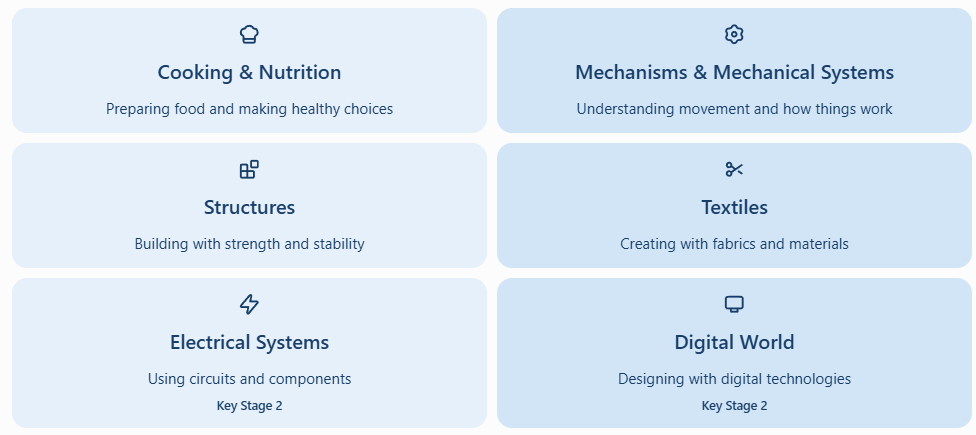
Our Design and Technology curriculum develops children's understanding through six practical areas of learning.
These areas help children explore how products work, understand the properties of materials and technologies, and develop the skills to design and make purposeful solutions.
Cooking and Nutrition – Understanding Food and Healthy Choices
Children learn about food, nutrition and the importance of a healthy, balanced diet.
They explore ingredients, where food comes from and how different foods can be prepared safely.
Through practical experiences, children develop skills in preparing ingredients, following recipes and understanding how food choices contribute to health and wellbeing.
As they progress, they become increasingly independent in selecting ingredients, preparing dishes and making informed decisions about food.
Mechanisms and Mechanical Systems – Understanding How Things Move
Children investigate how different mechanisms help products move and work.
They explore components such as wheels, axles, levers, sliders, linkages, pulleys and gears through practical design challenges.
Teachers explicitly introduce the technical knowledge needed to understand how movement is created, controlled and transferred.
Children apply this understanding to design and make increasingly sophisticated moving products.
Structures – Designing and Building with Strength
Children learn how structures are designed to be stable, strong and fit for purpose.
They explore different materials, shapes and joining techniques, investigating how these affect the strength and stability of a product.
Through practical challenges, children learn to construct, test and improve structures.
As their understanding develops, they make increasingly informed decisions about materials, reinforcement and design.
Textiles – Creating with Fabric and Materials
Children explore how textiles are used to create functional and purposeful products.
They develop practical skills in cutting, joining, shaping and finishing different materials.
Through explicit teaching, children learn techniques such as stitching, fastening and selecting suitable fabrics.
As they progress, they design and create textile products with increasing accuracy, independence and attention to the needs of the user.
Electrical Systems – Understanding Circuits and Components
In Key Stage 2, children develop an understanding of how electrical components can be used within designed products.
They explore circuits, switches and other components, learning how electrical systems can create movement, light or sound.
Children apply their knowledge to design and make functional products, testing how well their systems work and making improvements.
Digital World – Designing with Technology
In Key Stage 2, children explore how digital technologies can support the design and development of products.
They develop an understanding of programming, digital design and how technology can be used to control or improve systems.
Through practical challenges, children learn how digital tools can support creative thinking, problem-solving and the development of innovative products.
Thinking and Working Like Designers and Engineers
At Franciscan, children are explicitly taught that designers and engineers do more than make products. They identify needs, explore possibilities, apply technical knowledge, test ideas and make improvements.
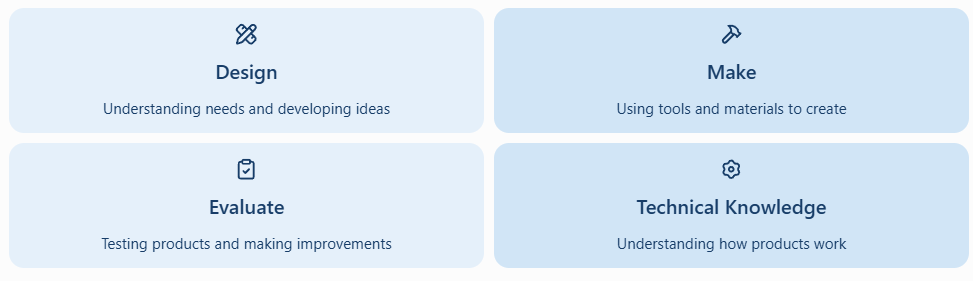
Our curriculum develops four interconnected strands.
Design – Exploring Problems and Generating Ideas
Children learn to identify a need or problem and consider who they are designing for.
They explore existing products, generate ideas and develop plans through discussion, drawing, modelling and research.
Children are explicitly taught to consider purpose, function, appearance and the needs of different users.
As they progress, they become increasingly confident in explaining and justifying their design decisions.
Make – Turning Ideas into Products
Children learn how to select and use tools, materials, components and techniques safely and effectively.
They develop practical skills through cutting, shaping, joining, assembling, preparing and finishing materials.
Teachers explicitly model techniques before children apply their knowledge through guided and independent practice.
As their confidence develops, children become more accurate, resourceful and independent in making products.
Evaluate – Testing, Reflecting and Improving
Children learn to test their products against their intended purpose and design criteria.
They are explicitly taught to identify strengths, recognise limitations and consider how products could be improved.
Through discussion, observation and practical testing, children learn to use evidence and feedback to refine their ideas.
They recognise that successful design often involves trial, error, reflection and improvement.
Technical Knowledge – Understanding How Products Work
Children develop the scientific and technical understanding needed to make effective design decisions.
They learn about materials, structures, mechanisms, electrical systems, food and digital technologies.
Teachers introduce important technical vocabulary and explain how different components and processes work.
Children apply this knowledge to solve problems and develop products that are increasingly functional, reliable and purposeful.
Our Approach to Teaching Design and Technology
At Franciscan, we believe that successful design develops through explicit teaching, practical exploration and purposeful problem-solving.
Teachers introduce new knowledge through clear explanations, demonstrations, examples of existing products and carefully planned design challenges. Children learn the technical knowledge and practical techniques needed before applying them to increasingly independent projects.
We teach children to think, speak and work like designers and engineers. This means identifying problems, asking questions, considering users, explaining design choices, testing ideas and using evidence to make improvements.
Children are explicitly taught how to use tools and materials safely, how different mechanisms and systems work, and how to make informed decisions about the suitability of materials and techniques.
Our approach encourages children to experiment, collaborate, persevere through challenges and recognise that designs can be improved through testing and reflection.
We also help children consider the wider impact of design. They explore how products meet people's needs, how materials and resources can be used responsibly, and why sustainability, accessibility and thoughtful design matter.
Teachers regularly revisit prior knowledge, check understanding and adapt activities to provide appropriate support and challenge.
Our aim is to develop knowledgeable, creative and resourceful children who can turn ideas into purposeful solutions and recognise their ability to make a positive difference.
How Design and Technology Develops Over Time
At Franciscan, children's understanding of design begins with their earliest experiences of exploring, constructing, experimenting and solving problems.
From Pre-school and Nursery through to Year 6, children progressively develop the knowledge, practical skills and confidence to design, make, test and improve products.
Pre-school and Nursery – Exploring, Building and Discovering
In our provision for two- and three-year-olds, children begin to develop early design thinking through play, construction and hands-on exploration.
They investigate materials, explore how objects fit together and experiment with building, stacking, joining and taking things apart.
Through everyday experiences, children begin to recognise simple problems and explore possible solutions.
Adults model language, demonstrate techniques and encourage children to make choices, test ideas and persevere when something does not work as expected.
These experiences develop curiosity, coordination, creativity and the foundations of practical problem-solving.
Reception – Designing, Making and Exploring Possibilities
In Reception, children build on their early experiences through purposeful opportunities to design, construct and create.
They explore materials, tools and simple techniques, developing increasing control and confidence.
Through activities such as junk modelling, making simple structures, exploring textiles and preparing food, children begin to understand how materials and processes can be used for different purposes.
Adults explicitly model safe tool use, introduce vocabulary and encourage children to explain their ideas, make choices and reflect on their creations.
This learning supports the EYFS area of Expressive Arts and Design, particularly creating with materials, alongside physical development and understanding the world.
Key Stage 1 – Building Practical Skills and Design Knowledge
In Years 1 and 2, children develop their understanding of the design process through practical challenges involving structures, mechanisms, textiles and food.
They learn to identify the purpose of a product, generate ideas, select suitable materials and use tools safely.
Children are explicitly taught practical techniques and begin to understand how simple mechanisms and structures work.
Through testing and evaluation, they learn to recognise what works well, identify improvements and explain their decisions.
As their confidence develops, children become increasingly independent in planning and creating purposeful products.
Key Stage 2 – Developing Innovation, Independence and Technical Understanding
In Years 3 to 6, children deepen their understanding of design, making and technical knowledge through increasingly complex projects.
They explore mechanical and electrical systems, digital technologies, structures, textiles and food preparation.
Children learn to research user needs, develop detailed designs, select appropriate materials and apply increasingly sophisticated techniques.
They are explicitly taught to test products against design criteria, analyse how well their solutions work and use evidence to make improvements.
Children also consider sustainability, accessibility and the wider impact of design decisions.
As they prepare for secondary school, they become increasingly confident in applying technical knowledge, solving complex problems and developing creative, purposeful solutions.

Working Together to Support Every Learner
At Franciscan, we believe that every child deserves the opportunity to become a confident designer, maker and problem-solver.
Teachers adapt learning through clear demonstrations, visual resources, practical modelling, accessible materials and appropriate support and challenge.
We recognise that children bring different experiences, strengths and perspectives to design challenges. Our curriculum provides opportunities for children to work collaboratively, communicate ideas and develop independence.
Children explore products, food cultures, materials and design traditions from different communities and around the world, helping them recognise that design is shaped by people's needs, experiences and environments.
Families play an important role in nurturing curiosity and practical problem-solving. Cooking together, building with everyday materials, exploring how household objects work and discussing ways to improve familiar products can all help children develop their design thinking.
We encourage families to celebrate the process of designing and making, recognising that testing ideas, overcoming difficulties and making improvements are important parts of learning.
Together, we nurture children who are creative, resilient and confident in their ability to turn ideas into meaningful solutions.
Curriculum Information and Useful Links
Our Design and Technology curriculum builds on children's early experiences within the Early Years Foundation Stage (EYFS) and follows the National Curriculum for Design and Technology in Years 1 to 6.
We use Kapow Primary resources to support carefully sequenced teaching across cooking and nutrition, mechanisms and mechanical systems, structures, textiles, electrical systems and the digital world.
Our curriculum develops children's ability to design, make and evaluate purposeful products while applying the technical knowledge needed to understand how things work.
Useful links
For further information about our Design and Technology curriculum, please contact the school office.