


Music
Every child a musician. Every voice matters. Every rhythm brings us together.
At Franciscan, we believe that music belongs to everyone. Music brings people together, provides opportunities for self-expression and helps children develop confidence, creativity and a sense of belonging.
Our Music curriculum is ambitious, inclusive and enriched through our partnership with Wandsworth Music. Through high-quality teaching from a specialist music teacher, children develop their musical knowledge, practical skills and appreciation of music across a range of traditions and styles.
From exploring sounds, rhythms and songs in Early Years to developing instrumental skills, performing and making music together in Key Stage 2, children are encouraged to discover their musical potential.
Rooted in our values of Respect, Kindness and Perseverance, we want every child to recognise that music is more than learning an instrument or performing a song. It is about listening, creating, expressing ourselves, working together and finding joy in shared musical experiences.

Music at Franciscan
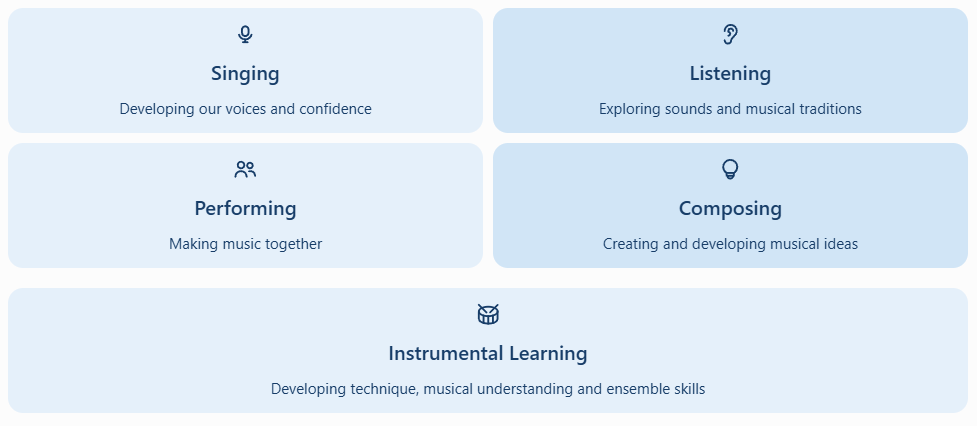
Our Music curriculum provides children with opportunities to develop musical understanding through singing, listening, performing, composing and learning instruments.
These experiences help children build the knowledge, confidence and practical skills needed to participate meaningfully in music.
Singing and Vocal Development – Every Voice Matters
Singing is an important part of our Music curriculum.
From Reception through to Year 6, children participate in singing projects that support their vocal development, musical confidence and enjoyment of performing together.
Children develop their ability to listen, sing with increasing control, recognise pitch and rhythm, and use their voices expressively.
Through specialist teaching and shared musical experiences, children learn that their voices are valuable and that singing together requires listening, cooperation and confidence.
Listening and Musical Appreciation – Understanding Music
Children are encouraged to listen carefully to music, recognise musical features and explore how music communicates different feelings and ideas.
They develop an understanding of musical elements such as pulse, rhythm, pitch, tempo, dynamics and timbre.
Through listening, discussion and practical exploration, children build the vocabulary needed to describe what they hear and explain their musical thinking.
We want children to appreciate music as an important part of cultural expression and human experience.
Performing – Making Music Together
Children develop confidence through opportunities to sing, play instruments and participate in shared musical activities.
They learn how to maintain a steady pulse, follow musical instructions, listen to others and contribute to a group performance.
As their skills develop, children become increasingly confident in playing together, responding to musical cues and recognising how individual contributions create a shared musical outcome.
Composing and Creating – Expressing Musical Ideas
Children develop their creativity through opportunities to explore, organise and combine sounds.
They learn how rhythm, pitch, dynamics and different instruments can be used to communicate musical ideas.
Through practical activities, children develop confidence in experimenting with sounds, recognising patterns and making musical choices.
These experiences help children understand that music is something they can create, explore and shape.
Instrumental Learning – Developing Musical Skills
Instrumental learning is an important feature of our curriculum and provides children with opportunities to develop technique, coordination, musical understanding and confidence.
Our specialist provision includes:
-
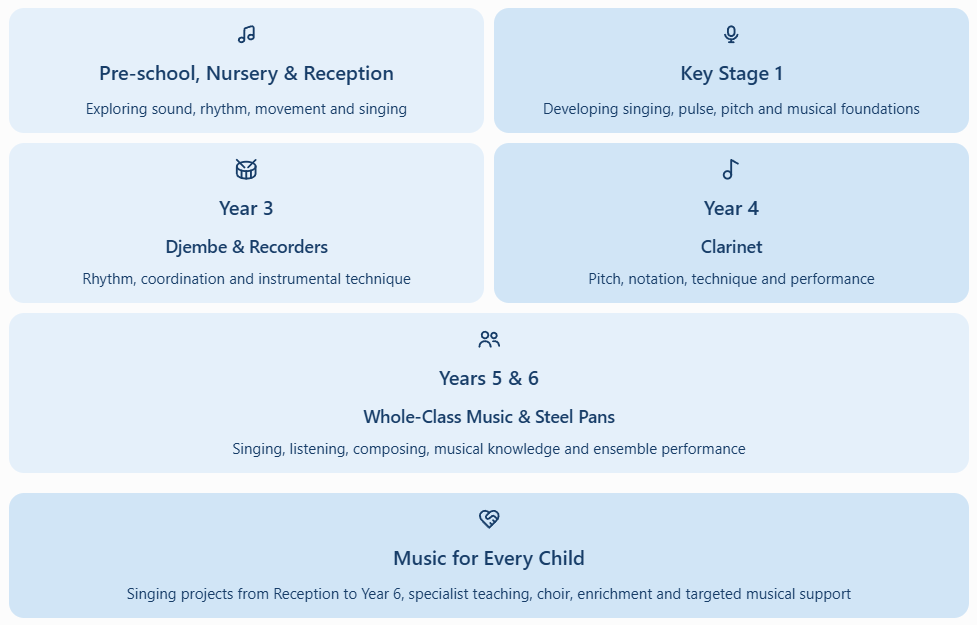
Year 3: Djembe drumming and recorders, developing rhythm, coordination, musical patterns and early instrumental technique.
-
Year 4: Clarinet, introducing children to wind-instrument technique and developing their understanding of pitch, notation and performance.
-
Years 5 and 6: Steel pans, providing opportunities to develop ensemble playing, rhythmic accuracy and musical expression.
Alongside this, targeted percussion interventions support children in developing engagement, rhythm, pattern and confidence through practical music-making.
Through these experiences, children encounter different musical traditions and learn how instruments contribute to individual and collective performance.
Our Approach to Teaching Music
At Franciscan, we believe that musical confidence develops through expert teaching, purposeful practice and opportunities to make music together.
Our partnership with Wandsworth Music provides specialist music teaching that supports children in developing their musical knowledge and practical skills.
New musical concepts and techniques are introduced through clear explanations, demonstrations, listening and guided practice. Children are supported to hear, recognise, practise and apply musical ideas.
We teach children to think, speak and work like musicians. This means listening carefully, recognising musical patterns, using appropriate vocabulary, responding to feedback and understanding how individual contributions support a shared performance.
Children develop their musical knowledge through active participation. They learn by listening, singing, moving, playing, experimenting and reflecting on what they hear and create.
Our relationship-centred approach is particularly important in Music. Children learn to listen to one another, collaborate, encourage others and recognise the value of every contribution.
We celebrate musical exploration and progress, recognising that children develop confidence and technical skills at different rates.
Through specialist teaching and meaningful musical experiences, we aim to nurture children who are knowledgeable, expressive and confident in their ability to participate in music.
How Music Develops Over Time
At Franciscan, children's musical development begins with their earliest experiences of sound, movement, rhythm and song.
From Pre-school and Nursery through to Year 6, children develop increasing confidence in listening, singing, performing and exploring music.
Pre-school and Nursery – Discovering Sound and Rhythm
In our provision for two- and three-year-olds, children begin their musical journey through songs, rhymes, movement and playful exploration.
They discover different sounds, experiment with simple instruments and begin to recognise patterns and rhythms.
Adults model songs, introduce musical language and encourage children to respond to music through movement, listening and participation.
These experiences help develop communication, coordination, confidence and enjoyment of music.
Reception – Finding Our Musical Voice
In Reception, children build on their early experiences through singing, listening and practical musical exploration.
They participate in our singing projects, beginning to develop vocal confidence, pitch awareness, rhythm and the ability to sing together.
Children explore sounds and instruments, respond to musical patterns and begin to recognise how music can express different feelings and ideas.
This learning supports the EYFS area of Expressive Arts and Design, particularly being imaginative and expressive.
Key Stage 1 – Building Musical Foundations
In Years 1 and 2, children develop their understanding of pulse, rhythm, pitch and musical expression.
Through singing, listening and practical music-making, they learn to recognise and reproduce simple musical patterns.
Children develop confidence in performing together, following musical instructions and using basic musical vocabulary.
They begin to explore how sounds can be organised and combined to create musical ideas.
These experiences establish important foundations for the specialist instrumental learning that follows in Key Stage 2.
Year 3 – Exploring Rhythm and Instrumental Technique
In Year 3, children develop their instrumental skills through djembe drumming and recorders.
Djembe provides opportunities to explore rhythm, pulse, coordination and ensemble playing, while recorder learning develops breath control, pitch awareness and instrumental technique.
Children build confidence in listening, following musical patterns and performing together.
Year 4 – Developing Musical Knowledge Through Clarinet
In Year 4, children learn the clarinet as part of their instrumental curriculum.
They develop their understanding of instrumental technique, breath control, pitch and musical notation.
Through regular practice and specialist instruction, children build confidence in playing melodies, listening carefully and performing as part of a group.
Years 5 and 6 – Developing Musical Knowledge, Instrumental Skills and Independence
In Years 5 and 6, children continue to receive whole-class music teaching from our specialist music teacher, developing their understanding of the wider music curriculum through singing, listening, composing and performing.
Children deepen their knowledge of musical elements, including rhythm, pitch, melody, notation and musical structure. Through explicit teaching and practical exploration, they develop the confidence to interpret, create and evaluate music, making increasingly informed musical choices.
Alongside this, children develop their instrumental skills through steel pan learning, strengthening their coordination, rhythmic accuracy, melodic understanding and ability to perform as part of an ensemble.
Particularly in Year 5, whole-class curriculum teaching provides opportunities to consolidate prior musical knowledge while exploring increasingly challenging musical concepts and creative approaches.
Targeted percussion interventions offer additional opportunities for children to develop rhythm, pattern, engagement and musical confidence.
As children prepare for secondary school, they become increasingly independent musicians who can listen critically, express themselves creatively, collaborate with others and recognise music as something they can continue to enjoy throughout their lives.
Music Beyond the Classroom
At Franciscan, music is an important part of our wider school community.
Our School Choir
Our school choir provides an additional opportunity for children to develop their singing, musical confidence and enjoyment of performing together.
Choir participation encourages commitment, collaboration, listening and a sense of shared achievement.
Music Clubs and Enrichment
Through our partnership with Wandsworth Music, we provide additional music clubs that extend children's opportunities to engage with music beyond their curriculum lessons.
These experiences help children explore musical interests, develop confidence and enjoy making music with others.
Targeted Music Sessions
We recognise that music can provide meaningful opportunities for children who benefit from additional support with engagement, rhythm, pattern and participation.
Our music interventions use practical musical experiences to help children build confidence, develop skills and experience success.
Music offers another way for children to connect, communicate and participate in school life.
Working Together to Support Every Learner
At Franciscan, we believe that every child deserves to experience the joy of music.
We recognise that children have different musical experiences, interests, abilities and starting points. Our approach ensures that every child is encouraged to participate and develop confidence.
Specialist teaching provides opportunities for children to learn through listening, movement, singing, practical exploration and instrumental performance.
Activities can be adapted to support children's individual needs, ensuring that music remains accessible and meaningful.
Our relationship-centred approach values collaboration, encouragement and the confidence to try something new.
We also celebrate the diversity of musical traditions represented within our school community, recognising that music provides a powerful connection between cultures, identities and experiences.
Families play an important role in nurturing children's musical interests. Singing together, listening to different styles of music, exploring rhythms and encouraging children to share what they have learnt can all support musical confidence.
Together, we nurture children who feel that their musical contributions matter and who recognise music as a source of creativity, connection and joy.
Curriculum Information and Useful Links
Our Music curriculum builds on children's early experiences within the Early Years Foundation Stage (EYFS) and is informed by the National Curriculum for Music in Years 1 to 6.
We work in partnership with Wandsworth Music, which provides specialist music teaching and supports our instrumental and wider musical offer.
Our curriculum provides opportunities for children to develop their musical understanding through singing, listening, performing, composing and instrumental learning.
Useful links
For further information about our Music curriculum, specialist teaching or enrichment opportunities, please contact the school office.
Music Mark Recognition
Music Mark is the UK Association for Music Education, championing and supporting access to music for all children and young people. Through this membership, our school can access a national calendar of training and events for professional development and networking, a library of resources for curriculum inspiration and advocacy, and regular newsletters with updates, sector news and opportunities.
We are proud to be recognised for our ongoing commitment to music and the arts, and we look forward to continuing to nurture creativity, confidence and collaboration through our music provision.
